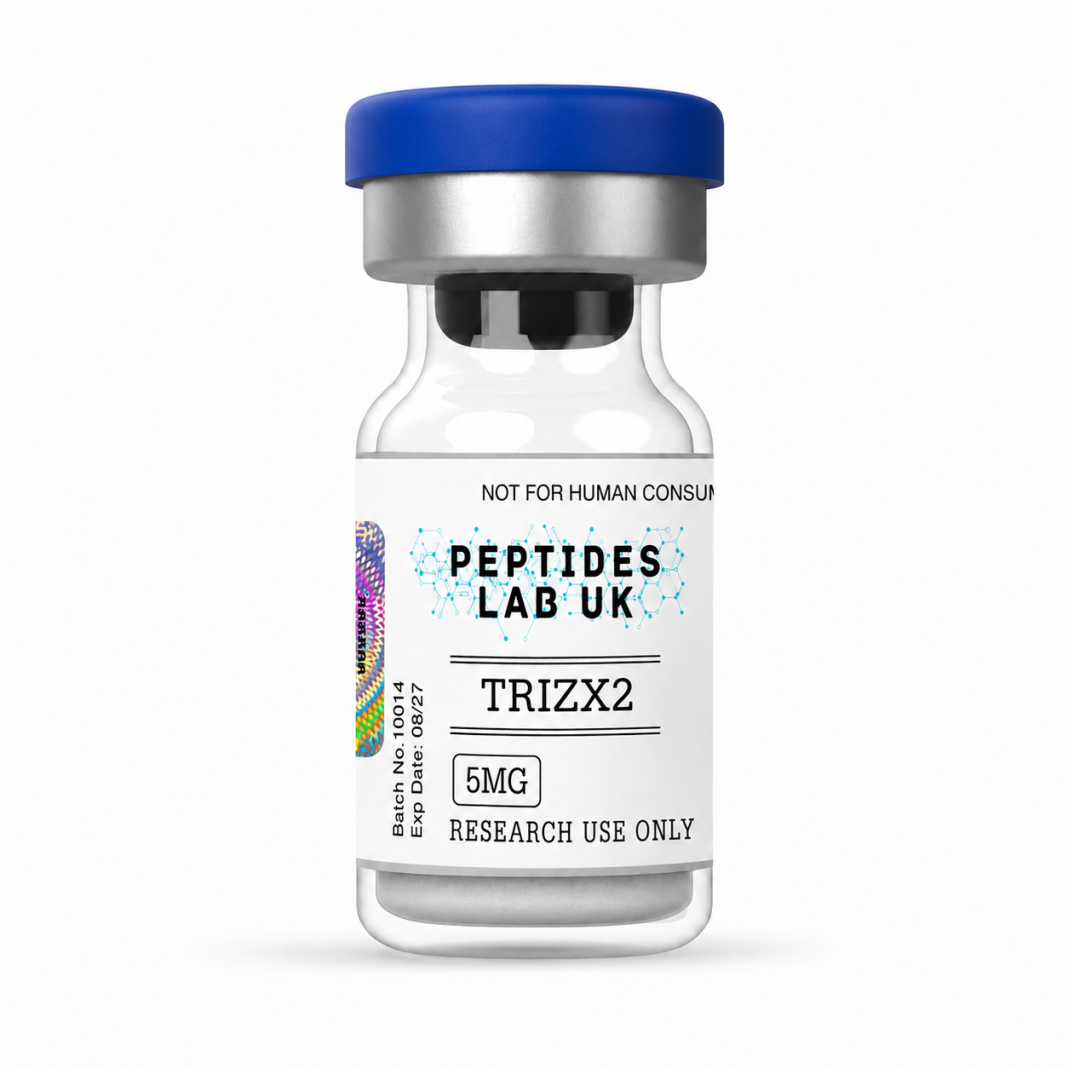
Tirzepatide is a synthetic 39-amino-acid peptide engineered as a dual receptor co-agonist, acting simultaneously on the glucose-dependent insulinotropic polypeptide (GIP) receptor and the glucagon-like peptide-1 (GLP-1) receptor. Its structure incorporates a C20 fatty diacid moiety conjugated via a linker to a modified GIP backbone, an acylation strategy that promotes reversible albumin binding and extends its plasma half-life to approximately five days, supporting once-weekly administration in the published clinical trial programme. Reported tirzepatide side effects, drawn from the Phase 3 SURPASS and SURMOUNT trial series, are dominated by gastrointestinal adverse events that follow a dose-dependent and escalation-phase-concentrated pattern. This article reviews the dual-receptor pharmacology underlying these effects, summarises the published trial safety datasets, and outlines the handling standards relevant to laboratories working with tirzepatide as a research compound.
Dual GIP/GLP-1 Receptor Pharmacology and Kinetics
Tirzepatide’s defining pharmacological feature is its co-agonist activity at two structurally related but functionally distinct incretin receptors. The GIP receptor and GLP-1 receptor are both class B G-protein-coupled receptors, and tirzepatide is engineered to bind both with substantial affinity, though published receptor-binding studies have reported that its binding affinity and functional potency at GIP receptors more closely approximates native GIP, while its GLP-1 receptor activity has been characterised in some studies as showing a biased agonism profile, meaning receptor activation preferentially engages certain downstream signalling pathways, such as cAMP generation, over others, such as beta-arrestin recruitment, relative to native GLP-1 or other GLP-1-selective compounds. This biased signalling profile has been proposed in the literature as a possible contributor to tirzepatide’s distinct efficacy and tolerability profile relative to single-receptor GLP-1 agonists, although researchers note that the precise contribution of biased agonism, as opposed to simple dual-receptor engagement itself, remains under active investigation.
The C20 fatty diacid acylation is central to tirzepatide’s pharmacokinetic profile. This lipid modification promotes non-covalent, reversible binding to serum albumin, which protects the peptide from rapid renal clearance and proteolytic degradation, extending its functional half-life to approximately five days in the published pharmacokinetic literature. This half-life is comparable to, and in some analyses longer than, that reported for once-weekly GLP-1-selective compounds, and it underlies the trial programme’s use of once-weekly subcutaneous administration together with a gradual dose-escalation schedule, moving from an initial low dose up through intermediate and maximal maintenance doses over a period of weeks, a titration approach adopted specifically to improve gastrointestinal tolerability during the early treatment period.
Mechanistically, tirzepatide’s actions can be divided into central and peripheral components, both relevant to understanding its reported adverse event profile. Peripherally, GLP-1 receptor activation on gastric tissue slows gastric emptying, a well-characterised incretin effect that contributes to prolonged satiety but is also directly implicated in gastrointestinal adverse events, including nausea, bloating and dyspepsia, particularly during the initial weeks of dose escalation before some degree of tolerance develops. Centrally, both GIP and GLP-1 receptors are expressed in hypothalamic and brainstem regions involved in appetite and satiety signalling, with receptor engagement in these regions contributing to reduced food intake independent of the peripheral gastric-emptying effect. Notably, GIP receptor signalling in specific brainstem neuron populations has been proposed in preclinical research to partially counteract the nausea-promoting effects of GLP-1 receptor activation in the same anatomical region, a finding with direct relevance to interpreting tirzepatide’s comparative gastrointestinal tolerability profile relative to single-agonist GLP-1 compounds, discussed further in the mechanism section below.
What Clinical Trial Datasets Show on Side Effects
The Phase 3 SURPASS trial programme, evaluating tirzepatide in participants with type 2 diabetes, and the Phase 3 SURMOUNT trial programme, evaluating tirzepatide in participants with obesity or overweight with or without type 2 diabetes, together constitute the principal published dataset for tirzepatide side effects. Across the pooled SURPASS-1 to -5 trials, encompassing 6,263 participants, a post hoc analysis reported nausea in 12 to 24 percent of participants, diarrhoea in 12 to 22 percent, and vomiting in 2 to 13 percent, with these gastrointestinal adverse events characterised as transient and of mild-to-moderate severity across the trial programme.
In the SURMOUNT-1 trial, published results specific to each dose cohort reported nausea in 24.6, 33.3 and 31.0 percent of participants receiving tirzepatide 5 mg, 10 mg and 15 mg respectively, with corresponding diarrhoea rates of 18.7, 21.2 and 23.0 percent, constipation rates of 16.8, 17.1 and 11.7 percent, and vomiting rates of 8.3, 10.7 and 12.2 percent. Treatment discontinuation due to adverse events was reported at 4.3 percent (5 mg), 7.1 percent (10 mg) and 6.2 percent (15 mg), compared with 2.6 percent in the placebo arm, and the trial sponsor characterised the overall safety and tolerability profile as generally consistent with other incretin-based therapies, with adverse events reported as mostly mild to moderate and concentrated during the dose-escalation period.
A pooled post hoc analysis across the SURMOUNT-1 to -4 trials, encompassing 4,726 participants, reported that the overall proportion experiencing gastrointestinal adverse events, including nausea, vomiting, diarrhoea and dyspepsia, ranged from 28.1 percent in SURMOUNT-2 to 48.5 percent in SURMOUNT-4, with the majority of events characterised as mild to moderate and resulting in tirzepatide discontinuation rates between 1.0 and 10.5 percent depending on the specific trial. The SURMOUNT-3 trial, which combined tirzepatide with an intensive lifestyle intervention following an initial weight-loss run-in period, reported modestly higher rates of gastrointestinal adverse events and treatment discontinuation compared with the SURMOUNT-1 15 mg cohort, a pattern the trial investigators noted was consistent with other studies combining pharmacotherapy with intensive lifestyle intervention (SURMOUNT-3 trial).
A systematic review and meta-analysis focused specifically on tirzepatide-induced gastrointestinal manifestations in people with type 2 diabetes consolidated findings across multiple published trials, reporting nausea, vomiting, decreased appetite, dyspepsia, constipation and diarrhoea as the principal gastrointestinal adverse events documented across the tirzepatide clinical trial literature, with the review noting that these effects may negatively affect drug tolerance despite the compound’s demonstrated efficacy on glycaemic and weight outcomes.
Serious adverse events have been reported only rarely across the tirzepatide clinical trial dataset. Individual trial safety records have documented isolated cases of serious gastrointestinal events, including obstructive pancreatitis, occurring at low single-digit-percentage rates in the highest dose cohort, though the overall serious adverse event rate across the trial programme has remained low relative to the frequency of mild-to-moderate gastrointestinal events described above.
Biochemical Mechanisms of Incretin-Mediated Adverse Events
The biochemical basis for tirzepatide’s gastrointestinal adverse event profile is understood to involve both peripheral and central mechanisms operating through its dual receptor activity. Peripherally, GLP-1 receptor activation on gastric smooth muscle and enteric neurons slows gastric emptying, a mechanism that supports prolonged satiety but that also directly contributes to nausea, bloating and dyspepsia when gastric emptying is substantially delayed, particularly during the initial weeks of treatment before gastric motility patterns adapt to sustained receptor engagement. The enteric nervous system, a semi-autonomous neural network embedded within the gastrointestinal wall, is understood to mediate much of this peripheral gastric-motility response, integrating incretin receptor signalling with local reflex control of gut motility and secretion.
Centrally, the area postrema, a sensory circumventricular organ located in the brainstem, has been identified as a critical site for incretin-mediated nausea signalling. This brainstem structure has a comparatively permeable blood-brain barrier, allowing resident neurons to directly sample circulating hormones and pharmacological compounds. Patch-clamp electrophysiology research using acute brainstem preparations has demonstrated that GLP-1 directly excites a substantial proportion of area postrema neurons through an adenylate cyclase-cAMP-dependent mechanism, and that this direct excitatory action is mechanistically linked to the induction of nausea-associated autonomic signalling (GLP-1 action in area postrema neurons study).
Notably, GIP receptor signalling within the same brainstem region has been reported to exert an opposing, inhibitory influence on this nausea-promoting circuit. Preclinical research across three species, mice, rats and musk shrews, has demonstrated that GIP receptor agonism blocks emesis and attenuates illness-associated behaviours elicited by GLP-1 receptor activation, while preserving the reductions in food intake, body weight and improved glucose tolerance associated with GLP-1 receptor engagement, an effect proposed to be mediated through GIP-receptor-expressing inhibitory neurons in the area postrema that locally suppress the nausea-promoting excitatory circuit activated by GLP-1 (GIP receptor agonism attenuates GLP-1-induced nausea study).
This dual-receptor interaction at the level of brainstem circuitry has been proposed as a mechanistic explanation for why tirzepatide’s gastrointestinal tolerability profile differs from that of single-receptor GLP-1 agonists in some comparative analyses, since simultaneous GIP receptor engagement may partially offset the nausea-promoting effect of GLP-1 receptor activation at this specific anatomical site, even as gastrointestinal adverse events remain the most frequently reported category of adverse event across the tirzepatide trial programme overall. Because gastrointestinal adverse events, particularly vomiting and diarrhoea, carry a risk of fluid and electrolyte loss, published clinical trial protocols and preclinical animal study designs have incorporated fluid maintenance monitoring as a standard safety measure during dose-escalation phases, reflecting the recognised biochemical link between incretin-receptor-mediated gastrointestinal effects and downstream fluid balance considerations in both clinical and preclinical research settings.
Research Applications and Comparative Incretin Protocols
Within laboratory settings, tirzepatide research compound is used across several established pharmacological research contexts. Dual receptor binding affinity assays represent a core application, in which researchers use radioligand or fluorescence-based binding techniques to characterise tirzepatide’s comparative affinity and functional potency at the GIP receptor versus the GLP-1 receptor, often benchmarked against native GIP, native GLP-1, and single-receptor-selective reference compounds. Islet beta-cell insulin secretion models constitute a further major research application, using isolated pancreatic islet preparations or beta-cell lines to examine glucose-dependent insulin secretion in response to tirzepatide exposure, allowing researchers to isolate the compound’s dual-receptor-mediated insulinotropic activity from its broader systemic metabolic effects observed in animal or clinical studies.
Cellular signal transduction mapping is used to characterise the specific downstream signalling pathways engaged by tirzepatide at each receptor, including cAMP generation, beta-arrestin recruitment and other pathway-specific readouts relevant to the biased agonism profile discussed in the mechanism section above. This research area has particular relevance for researchers seeking to understand how tirzepatide’s signalling profile at the GLP-1 receptor differs from that of GLP-1-selective agonist compounds, informing broader research into how biased receptor signalling may relate to the differential efficacy and tolerability profiles reported across the incretin compound class.
Comparative GLP-1 versus GIP/GLP-1 research setups represent a particularly active area of investigation, in which researchers directly compare tirzepatide against single-receptor GLP-1 agonist compounds across matched cell culture or animal-model protocols, examining differences in receptor engagement, downstream signalling and functional outcomes such as insulin secretion or gastric motility markers. When selecting a high-purity Tirzepatide research compound for cellular binding assays or dual-receptor signal transduction studies, researchers should confirm that the supplied peptide sequence and C20 fatty diacid acylation are independently verified in the accompanying documentation, since the acylation moiety is structurally distinct from the peptide backbone and is relevant to both receptor engagement and pharmacokinetic behaviour in comparative assay protocols.
Purity, Analytical Verification, Storage and Handling
Research-grade tirzepatide should be accompanied by a certificate of analysis confirming purity by HPLC, typically at or above 98 percent, together with mass spectrometry verification confirming both the correct 39-amino-acid peptide sequence and the structural integrity of the C20 fatty diacid acyl chain. Because tirzepatide’s dual-receptor activity and extended pharmacokinetic profile both depend on the intact acylation moiety in addition to accurate peptide sequence synthesis, analytical verification of this compound is somewhat more complex than for unmodified research peptides, and researchers should request documentation that specifically addresses the acylated structure rather than accepting a general peptide purity certificate alone.
Peptide sequence stability is a further consideration relevant to tirzepatide specifically, since the fatty diacid conjugation site represents a potential point of chemical vulnerability during storage and handling if not properly characterised and quality-controlled during synthesis. When UK research institutions evaluate published clinical datasets regarding tirzepatide side effects alongside dual-receptor stability assays, verifying batch purity via analytical documentation that addresses both the peptide backbone and the acylated side chain is essential to ensuring that laboratory findings can be meaningfully related to the trial-derived pharmacological profile described in the published literature.
Lyophilised tirzepatide should be stored at -20°C, protected from light and moisture, in order to preserve both peptide sequence integrity and the fatty diacid acylation prior to reconstitution. Once reconstituted, the compound should be handled promptly and kept refrigerated at 2-8°C, since reconstituted acylated peptides can be susceptible to degradation through both standard peptide bond hydrolysis and potential instability at the acylation site under inappropriate buffer conditions. Buffer selection for reconstitution should account for the compound’s albumin-binding properties, and researchers should follow supplier-specific reconstitution guidance rather than assuming that protocols developed for unmodified, non-acylated research peptides transfer directly to this class of compound. Aliquoting reconstituted material into single-use volumes is recommended to minimise freeze-thaw exposure across an experimental run.
Frequently Asked Questions
Why are gastrointestinal side effects concentrated during the dose-escalation phase of tirzepatide trials?
Published trial data indicates that gastrointestinal adverse events, including nausea, diarrhoea and vomiting, occur most frequently during the initial weeks of treatment when doses are being gradually increased toward a target maintenance level. This pattern is consistent with a period of physiological adaptation to incretin receptor engagement, and trial protocols have used gradual titration schedules specifically to mitigate the frequency and severity of these effects during this phase.
Does tirzepatide’s dual GIP/GLP-1 activity change its gastrointestinal side effect profile compared with GLP-1-only compounds?
Preclinical research has reported that GIP receptor signalling in specific brainstem neuron populations can attenuate nausea-promoting effects associated with GLP-1 receptor activation in the same region, suggesting a mechanistic basis for potential differences in tolerability. However, published clinical trial data still shows gastrointestinal adverse events as the most frequently reported category with tirzepatide, and comparative network meta-analyses have reported varying relative risk findings across the incretin compound class.
How does dose level affect the frequency of tirzepatide-associated adverse events in trial data?
SURMOUNT-1 trial data reported nausea, diarrhoea and vomiting rates that generally increased from the 5 mg to 10 mg dose cohorts, with some variation at the highest 15 mg dose depending on the specific adverse event, indicating an overall but not perfectly linear dose-dependent relationship across the studied dose range.
What documentation should accompany research-grade tirzepatide given its acylated structure?
Researchers should request a batch-specific certificate of analysis confirming HPLC purity of 98 percent or higher, along with mass spectrometry confirmation addressing both the 39-amino-acid peptide sequence and the C20 fatty diacid acylation, since verification of the acyl chain is necessary in addition to standard peptide sequence confirmation for this class of modified research compound.
Tirzepatide research compound, as supplied by Peptides Lab UK and comparable UK research suppliers, is intended strictly for in-vitro and animal-model laboratory research. It is not licensed or intended for human or veterinary administration outside registered clinical trials, and the trial data summarised here describes outcomes recorded within formally supervised clinical trials, not a basis for personal or unsupervised us.