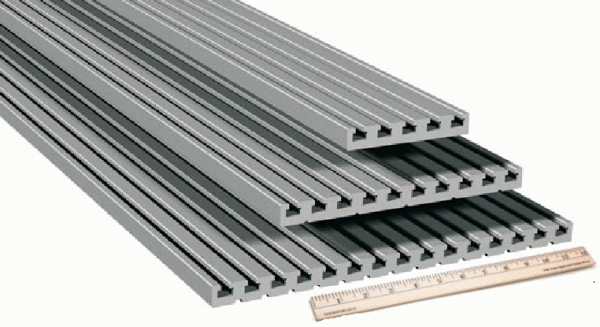
Strong modular frames do not happen by accident. The performance of an extruded aluminum T slot system depends on material selection, dimensional accuracy, and internal design details that are often overlooked. Understanding these structural traits helps engineers and fabricators select MiniTec Aluminum Framing or similar systems with confidence.
High-Grade AlMgSi 0.5 F25 Aluminum Alloy Composition
The foundation of a reliable extruded aluminum T slot profile begins with the alloy. AlMgSi 0.5 F25 aluminum offers a balanced combination of strength, corrosion resistance, and machinability. Magnesium and silicon work together to create a material that maintains stability under load without becoming brittle. This alloy also responds well to heat treatment, improving tensile strength while keeping weight low. In modular framing applications, that balance matters. A T slot aluminum extrusion built from high-grade alloy can support structural components, safety guards, or machine bases without unnecessary bulk. Engineers relying on MiniTec extruded aluminum framing often select this composition because it performs consistently across varied industrial conditions.
Precision Tolerances for T-Slot Geometry and Straightness
Dimensional accuracy directly affects how components assemble. Tight tolerances ensure each T slot extrusion aligns properly with connectors, fasteners, and brackets. Even minor deviations in slot width or wall straightness can lead to misalignment during assembly.
Consistent geometry reduces installation time and improves structural integrity. When every profile matches expected measurements, hardware slides smoothly into place. MiniTec Aluminum Framing systems often emphasize precise extrusion processes to maintain straightness along the full length of each profile. Reliable tolerances support modular builds that remain square and true.
Internal Center Bore Designed for M8 Powerlock Fasteners
Many high-quality T slot aluminum extrusion designs include a center bore specifically sized for M8 Powerlock fasteners. This feature simplifies internal connections and improves load transfer between joined sections.
An accurately machined center bore allows fasteners to seat securely without additional machining. By integrating this detail directly into the extruded aluminum T slot profile, manufacturers streamline assembly while maintaining structural strength. Properly sized bores prevent slippage and help distribute forces evenly across connected profiles.
Hard-Anodized Surface Treatment for Scratch Resistance
Surface treatment influences durability as much as internal structure. Hard-anodizing creates a protective oxide layer that increases resistance to scratches and wear. In industrial environments, framing often encounters tools, moving components, and frequent adjustments.
A hardened surface maintains its appearance and structural quality longer than untreated aluminum. Anodizing also enhances corrosion resistance, particularly in humid or mildly corrosive settings. MiniTec extruded aluminum framing commonly incorporates such treatments to extend service life while reducing maintenance demands.
Uniform Groove Dimensions for Universal Hardware Compatibility
The grooves within a T slot extrusion must maintain consistent dimensions along the entire profile. Uniform slots allow hardware components to fit securely and remain interchangeable across multiple assemblies.
Compatibility supports modular flexibility. Engineers can rearrange frames, add accessories, or replace sections without modifying slots. With extruded aluminum T slot systems designed for universal hardware, adjustments become straightforward. This consistency enhances adaptability across production lines and machine builds.
High Torsional Rigidity Provided by Internal Webbing
Internal webbing strengthens a profile without adding excessive weight. Strategic internal ribs resist twisting forces that could compromise frame stability. Torsional rigidity is especially important in tall structures or assemblies exposed to lateral loads.
Effective webbing design allows a T slot aluminum extrusion to withstand rotational stress during operation. Frames built from well-reinforced profiles maintain alignment under dynamic conditions. MiniTec Aluminum Framing often incorporates internal structural features that enhance rigidity without sacrificing ease of assembly.
Consistent Wall Thickness for Maximum Load-Bearing Capacity
Wall thickness directly affects how much weight a profile can support. Uneven thickness can create weak points that reduce overall strength. High-quality extrusions maintain consistent wall dimensions throughout the cross-section.
Uniform thickness ensures predictable performance under load. This reliability matters when supporting machinery, conveyors, or workstations. Engineers working with MiniTec extruded aluminum framing value consistent wall geometry because it simplifies structural calculations and ensures dependable load capacity.
Flat Profile Faces for Seamless Component Integration
Flat profile faces allow panels, brackets, and covers to mount securely. Smooth surfaces improve alignment and reduce gaps between components. A clean interface enhances both structural performance and visual finish.
Well-finished faces also simplify sealing and attachment of accessories. Extruded aluminum T slot systems designed with flat, consistent surfaces integrate more easily into larger assemblies. Attention to surface geometry helps create frames that look precise and function reliably.
Minitec Solutions supports modular design projects by providing high-quality T slot aluminum extrusion systems engineered for strength and flexibility. Their team assists customers in selecting MiniTec Aluminum Framing configurations tailored to specific structural requirements. Through dependable materials, accurate extrusion processes, and comprehensive support, Minitec Solutions helps manufacturers build modular systems that perform with confidence