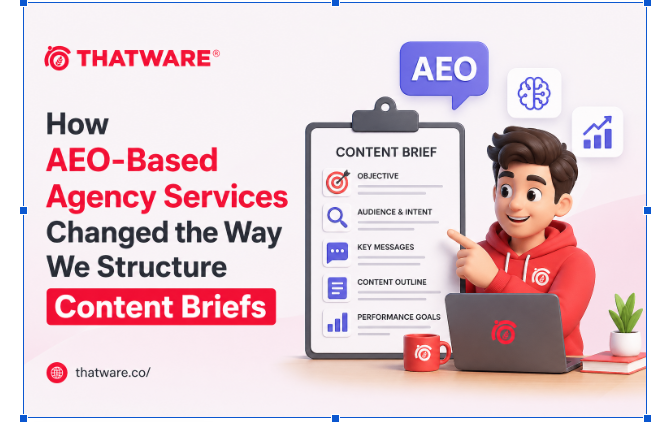
The content brief used to be a fairly simple document. Target keyword. Secondary keywords. Word count. Competitor URLs to reference. Maybe a few questions from “People Also Ask” to work in. The writer takes it, fills in the blanks, and the result goes into the queue.
That approach worked for a long time. In some niches it still works fine. But for anyone producing content in categories where AI-driven search results are increasingly where users actually get their answers, that brief is no longer fit for purpose.
Working with an AEO based agency reframes the whole thing – from the structure of the brief to what constitutes a successful outcome.
What AEO Actually Is and Why It Matters Now
AEO – ask engine optimization – is exactly what it sounds like. It’s optimization for the query layer that AI systems handle: direct questions, conversational queries, “what is,” “how does,” “why does” type searches. The shift in search behavior toward question-based queries has been happening for years, accelerated by voice search, and now fully amplified by the prevalence of AI chatbots and answer engines like Perplexity.
The content that wins in this context isn’t just well-written. It’s structurally designed to function as an answer. That means being precise, having a clear top-line response before supporting details, anticipating follow-up questions, and being quotable – in the sense that a short passage from the content could stand alone as a complete, useful answer.
Three Concrete Ways the Brief Changes with AEO Thinking
What changes in the brief when you apply AEO thinking? A few things, pretty concretely.
First, the framing shifts from keyword to question. Instead of “target keyword: content marketing strategy,” the brief might say “primary question: how does content marketing strategy differ for B2B vs B2C?” That’s a small framing change with big downstream effects. Writers structure content differently when they’re answering a question rather than covering a topic.
Second, the brief starts specifying answer architecture. Where is the direct answer? Is it in the first paragraph, clearly stated before any qualifying context? Are there follow-up questions explicitly addressed? Is there a summary section at the end that could function as a standalone featured snippet?
Third, source and citation guidance gets more serious. For aeo based platform services, the credibility of the answer matters as much as its structure. The brief should specify what claims need citations, what kinds of sources are appropriate, and how expert attribution should be handled.
How Brief Length and Depth Actually Shift
The brief also gets shorter in some ways, longer in others. Shorter because you’re not trying to cover a topic comprehensively for its own sake – you’re answering specific questions, which requires focus rather than breadth. Longer because the structural guidance gets more explicit: here’s the question, here’s the format the answer should take, here are the follow-up questions to address, here’s how the content should be structured so it’s machine-parseable.
That more explicit structure initially feels like micromanagement to some writers. It isn’t. It’s actually more respectful of their craft – you’re giving them a clear job to do rather than a vague directive to “write a good article about X.”
The Research Process Changes Too
One thing that surprised me when working through this shift: the research process changes too. AEO-focused content requires really understanding the query landscape – not just what questions people ask, but in what sequence, at what point in their decision journey, with what underlying intent. “How to choose a CRM” is a different question from “what is a CRM” even though they share keywords. The person asking the first is further along, more specific, more ready to engage with nuance.
Mapping that query journey upfront – before writing a single word – produces better content and better briefs. It’s the kind of research that takes more time but collapses a lot of the revision cycles that come from getting the framing wrong on the first draft.
The Measurable Results of Getting This Right
The results, when this shift is done well, are measurable. Featured snippet rates go up. Time-on-page often goes up too – which seems counterintuitive for concise, answer-focused content, but makes sense when you realize that content designed to directly answer questions tends to earn trust and keep readers engaged with follow-up exploration.
More importantly, the content starts showing up in AI-generated answers. Which, increasingly, is where the discovery happens.
Restructuring the content brief was the smallest intervention with the largest downstream effect. It’s not glamorous work. But it’s probably the most important operational change a content team can make right now.